
Motivation
When a long-term health portfolio undergoes a rate revision, coverage
restructure, or underwriting overhaul, cohorts after that event behave
differently from earlier ones. Fitting chain ladder on the full triangle
lets old-cohort link factors leak into the new-cohort projections, which
shows up as a monotone drift across diag_summary in
backtest().
The recent = N argument suppresses some of this drift,
but a calendar-diagonal cut is symmetric across both axes — it discards
older cohorts’ young-dev cells too, where the ED region was already
stable. The natural fix is asymmetric:
- Pre-maturity (ED region): horizontal cut — keep only post-break cohorts.
-
Post-maturity (CL region): diagonal cut — keep only
the recent
Ncalendar diagonals.
regime_break implements that split.
Two-axis asymmetry
| Axis | Number of changes | Source |
|---|---|---|
| x (maturity, ED → CL) | exactly one per group | fit_ata$maturity |
| y (regime break) | zero or many per group | detect_cohort_regime$breakpoints |
The maturity point
is a single internal switch produced by
find_ata_maturity(). Regime breaks are exogenous events —
there can be none, one, or several. When regime_break
receives multiple values, the most recent is used,
since post-break statistics are most stable when the post-break window
has accumulated the largest number of cohorts.
API
regime_break is a shared argument on
fit_ata, fit_ed, and fit_lr. It
accepts:
| Input | Behaviour |
|---|---|
NULL (default) |
no filtering — backwards compatible |
Date or character scalar |
single break date |
| Date/character vector | uses the latest entry |
CohortRegime object |
output of detect_cohort_regime() passed in |
library(lossratio)
data(experience)
exp     <- as_experience(experience)
tri_sur <- build_triangle(exp[cv_nm == "SUR"], cv_nm)

# Single break date
fit_lr(tri_sur, method = "sa", recent = 18L,
       regime_break = "2024-04-01")

# CohortRegime object directly
reg <- detect_cohort_regime(tri_sur)
fit_lr(tri_sur, method = "sa", recent = 18L, regime_break = reg)

# Vector — latest is used (= 2024-04-01)
fit_lr(tri_sur, method = "sa",
       regime_break = c("2023-06-01", "2024-04-01"))
In simple modes (fit_ata, fit_ed, or
fit_lr(method ∈ {"ed","cl"})) the same argument acts as a
plain cohort cut.
SA-mode hybrid behaviour
The hybrid split activates only for
fit_lr(method = "sa") with both regime_break
and recent:
- dev ≤ — ED region: post-break cohorts only.
- dev >
— CL region: latest
recentdiagonals only (full triangle ifrecent = NULL).
The maturity point itself is found in a two-pass procedure: first on the raw triangle (so noisy post-break windows do not destabilise ), then the hybrid filter is applied to the actual fit using the fixed .
plot_triangle(type = "usage") visualises which cells
each filter configuration feeds to fit_lr:
plot_triangle(tri_sur, type = "usage", holdout = 6L)                                 # full
plot_triangle(tri_sur, type = "usage", recent = 12L, holdout = 6L)                   # recent
plot_triangle(tri_sur, type = "usage", regime_break = "2024-04-01", holdout = 6L)    # break
plot_triangle(tri_sur, type = "usage", recent = 12L,
              regime_break = "2024-04-01", holdout = 6L)                             # hybrid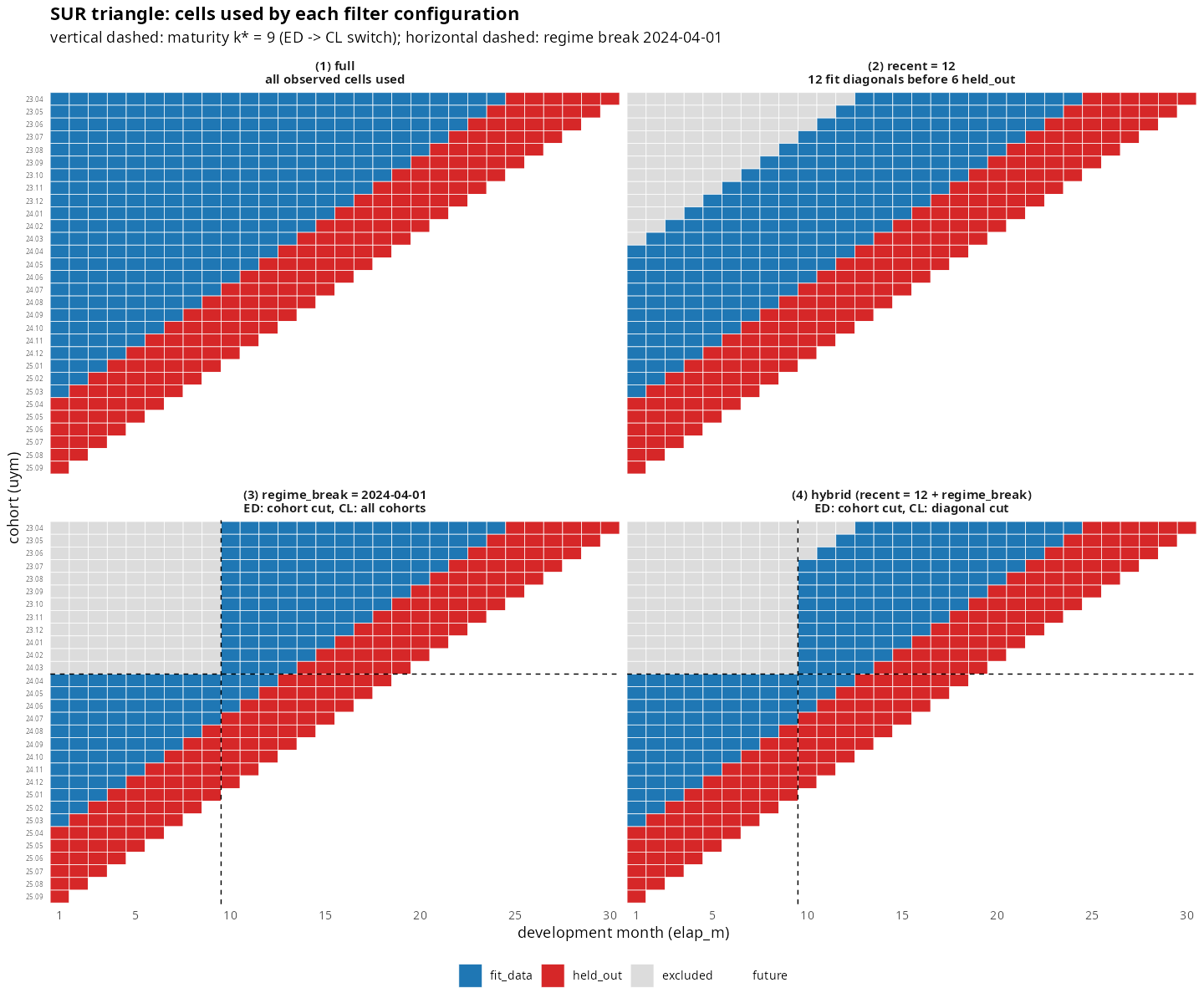
The hybrid panel shows the dev-axis split that SA mode applies: a cohort cut on the ED side and a calendar diagonal cut on the CL side, joined at .
Case study — SUR cohort
The bundled experience dataset embeds a synthetic
2024-04 break in the SUR coverage. Backtests on the same triangle with
four variants:
reg <- detect_cohort_regime(tri_sur)

bt_full   <- backtest(tri_sur, holdout = 6L)
bt_recent <- backtest(tri_sur, holdout = 6L, recent = 18L)
bt_break  <- backtest(tri_sur, holdout = 6L,
                      regime_break = reg)
bt_hybrid <- backtest(tri_sur, holdout = 6L, recent = 18L,
                      regime_break = reg)
Reproduced from dev/regime_backtest_hybrid.R:
| Variant | drift (cal30 − cal25) | overall mean |
|---|---|---|
| full | +4.50pp | -1.25% |
| recent = 18 | +2.03pp | -3.45% |
| regime_break + recent = 18 | -0.69pp | +0.03% |
Two columns summarise the AEG = actual / pred − 1
(positive = under- projection) measured on the held-out diagonals:
- drift (cal30 − cal25): AEG aggregated by calendar diagonal, then the (latest − earliest) difference. Captures whether the prediction error is monotonically changing across the hold-out window — the signature of a regime that the static model has not absorbed.
- overall mean: cell-level mean AEG across all held-out cells — the model’s directional bias.
Drift collapses from +4.50pp under full to -0.69pp under
the hybrid filter; the overall mean returns to ~0. The hybrid joins two
axis cuts at
:
a cohort cut on the ED side (dev ≤ k*) and a calendar diagonal cut on
the CL side (dev > k*).
Multi-group handling
detect_cohort_regime() assumes a single-group triangle.
For a portfolio with multiple cv_nm groups, call it per
group:
fits <- lapply(unique(exp$cv_nm), function(g) {
  tri_g <- build_triangle(exp[cv_nm == g], cv_nm)
  reg_g <- detect_cohort_regime(tri_g)
  fit_lr(tri_g, method = "sa", recent = 18L,
         regime_break = reg_g)
})
A future extension may accept
regime_break = list(SUR = "2024-04-01", CAN = "2023-12-01").
Today only scalar / vector / CohortRegime are
supported.
Limitations
If the post-break window is too short (small n_post),
the ED intensity
and link factors
become noisy. A practical threshold is n_post ≳ 6. Below
that, prefer recent alone, or wait for credibility-weighted
blending of pre- and post-break factors (planned).
Note also that regime_break only filters the data
feeding link factor estimation. Once the factors are fixed, all cohorts
share them, so pre-break ultimates inherit the post-break dynamics.
See also
-
vignette("loss-ratio-methods")—fit_lr()and the"sa","ed","cl"methods. -
vignette("backtest")— diagnosing the impact ofrecentandregime_break. -
vignette("regime-detection")—detect_cohort_regime()reference. -
?fit_lr,?fit_ata,?fit_ed,?detect_cohort_regime.